:strip_exif()/reboot/media/fcfbe306-5e5d-11f1-9cc2-86f89b305e2b/44ccacc0-028b-11ed-9755-0242ac14000a/poster-0.jpg)


ATP in brief:
The Agreement on the International Carriage of Perishable Foodstuffs (ATP) relates to international transport and the equipment used for such transport. The ATP is a United Nations agreement signed by 52 countries and sets out the requirements for the means necessary for temperature-controlled transport (refrigerated transport):
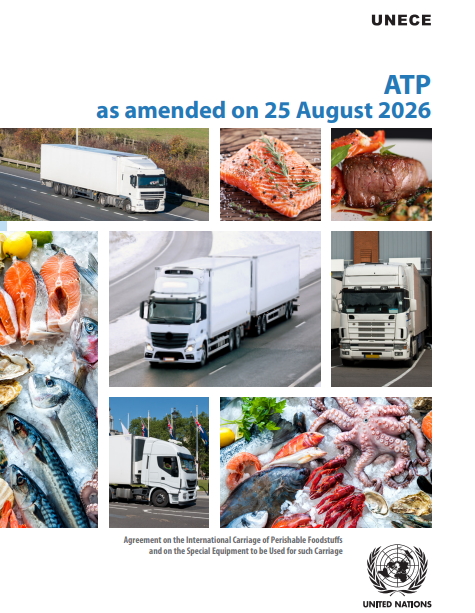
Version of the ATP agreement valid since August 25, 2026
The implementation of the ATP agreement in France:
For domestic transport, national regulations require the use of vehicles with an ATP technical conformity certificate or a national certificate. An exemption to this requirement is possible for journeys of less than 80 km without transshipment, meaning without opening the doors.
How to recognize a compliant vehicle?
Every vehicle in operation subject to the ATP (Agreement on the international carriage of perishable foodstuffs and on the special equipment to be used for such carriage) or national regulations must have a valid technical conformity certificate (paper). Marking stickers are affixed to the top and front, on both sides of the vehicle's body. Blue for ATP certifications, red for national certifications, the marking code identifies the vehicle's refrigeration technology, its thermal insulation, and its class.

Example of a marking affixed to a transport vehicle
Class C refrigerated and insulated
Who issues ATP conformity certificates and national certificates?
The Datafrig® information system centralizes applications for certificates for new equipment and for the renewal of equipment at 6, 9, and 12 years. Certificates are issued by Cemafroid , in France, by delegation from the Ministry of Agriculture.
What are the steps for a vehicle to obtain ATP certification?
- For new equipment, each prototype of the body, refrigeration unit, or machine must undergo type testing at an official ATP testing station to obtain an official test report defining the thermal characteristics required by regulations. Equipment manufacturers with an official test report must be authorized to guarantee that their production conforms to the approved equipment types.
- Authorization is granted based on an audit of the manufacturer according to a standard validated by the Ministry. Periodic audits are conducted to verify the manufacturer's continued compliance with the standard's requirements. Once authorized, for each machine manufactured according to a certified type, an individual technical conformity certificate request is submitted to Cemafroid using the Datafrig® application.
- Equipment in service with a certificate must successfully complete a descent or temperature maintenance test at 6 years and then again at 9 years in a testing center recognized by the Ministry of Agriculture, based on a technical standard. Audits based on this testing center standard are carried out by Cemafroid.
- After 12 years, the equipment must undergo a renewal test at an official ATP testing station . Renewal is granted for a period of 6 years and can be carried out for a single batch. The certificate must then be renewed every 6 years.
What happens if the vehicle is modified or sold ?
Any major modification to the refrigerated transport vehicle requires an update of the ATP certificate. This update can be done, depending on the circumstances, with or without testing at a testing center. The equipment owner must submit their request either to the authorized manufacturer or to an authorized testing center.
In the event of a change of ownership of a vehicle, the new owner must request an amendment to their certificate from an approved testing center. If they do not wish to have the test carried out, they must waive this right in writing to the testing center.
What are the rules for importing a vehicle into France?
- If the machine has an ATP certificate from the country of origin, the applicant sends Cemafroid a request for certification including the test reports of the body, the group and the certificates issued by the competent authority of the country of manufacture.
- In all other cases, ATP certificates are issued for imported equipment based solely on the administrative criteria imposed by the ATP. The certificate issued by Cemafroid on this basis does not refer to Cemafroid's ISO 17065 accreditation.
- If the equipment does not have an ATP certificate from its country of origin and the manufacturer is not authorized, the equipment is subject to testing at an official ATP testing station. If the test is successful, the certificate is issued.
Are there any special cases?
There are special cases for certain transport vehicles or equipment such as:
- small containers with a volume of less than 2 m³,
- tanks for food liquids,
- and insulated packaging solutions used for transporting perishable goods.
Special provisions also exist for overseas departments (DOM).
:strip_exif()/reboot/media/fcfbe306-5e5d-11f1-9cc2-86f89b305e2b/099c4c1e-777b-11ec-950a-0242ac130008/0-0-aerial-photo-of-buildings-during-dusk-bolgim0qwkg-jpg.jpg)